

Delhi Ridge: The Ancient Forest That Breathes Life Into the Capital
Delhi is a city of contrasts—where Mughal domes meet glass towers, and honking traffic flows beside centuries-old ruins. But hidden amid the chaos is a mysterious, ancient forest older than the Himalayas, known as the Delhi Ridge.
Often called the Green Lungs of Delhi, this sprawling stretch of forest is more than just a nature trail—it’s a silent witness to empires, wars, folklore, and ecological evolution. In this article, we dive deep into the history, biodiversity, and secrets of the Ridge, revealing why it’s one of Delhi’s most underrated wonders.
Older Than the Himalayas: A Billion-Year-Old Landscape
The Delhi Ridge is part of the Aravalli Range, which dates back 1.5 billion years, making it one of the oldest surviving geological formations in the world. To put that in perspective, the Himalayas are just 50 million years old.
This means the rocks beneath your feet as you walk through the Ridge were already ancient when the first human civilizations were forming.

Delhi’s Green Lungs: Nature’s Breath in an Urban Jungle
Spanning over 7,700 hectares, the Ridge is the city’s largest green buffer. It plays a crucial role in:
Absorbing air pollutants
Reducing urban heat
Supporting rainwater recharge
Acting as a biodiversity hotspot
It’s home to over 200 species of trees, 100+ bird species, and animals like jackals, porcupines, wild boars, and even leopards in the southern zone.
Without the Ridge, Delhi’s already toxic air would be far worse.

A Natural Barrier Against the Desert
Historically, the Ridge served as a windbreak against the advancing Thar Desert. Without it, Delhi could’ve become semi-arid like parts of Rajasthan.
The Ridge preserved the region’s agricultural fertility and temperate microclimate, allowing ancient civilizations to thrive here.

A City Divided by Trees: The Four Ridges of Delhi
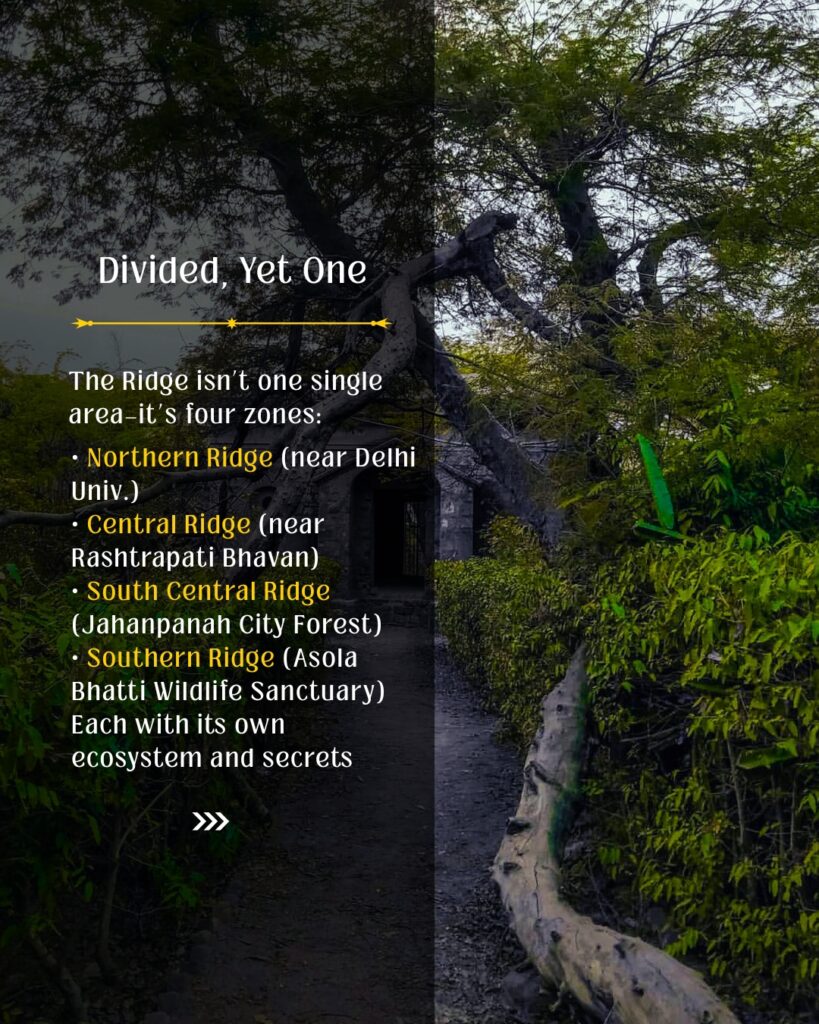
The Ridge isn’t one single continuous forest but is divided into four main zones:
Northern Ridge: Near Delhi University, it’s the smallest but historically significant—this area was a base during the 1857 revolt.
Central Ridge: Extends from the Presidential Estate to Sadar Bazaar. Dense and less accessible.
South Central Ridge: Includes the Jahanpanah City Forest, a lesser-known yet beautiful walking zone.
Southern Ridge: The Asola Bhatti Wildlife Sanctuary, the largest portion, teeming with wild species and geological diversity.
Each zone has its own ecosystem, story, and vibe.
The Haunted Heart: Bhuli Bhatiyari Ka Mahal
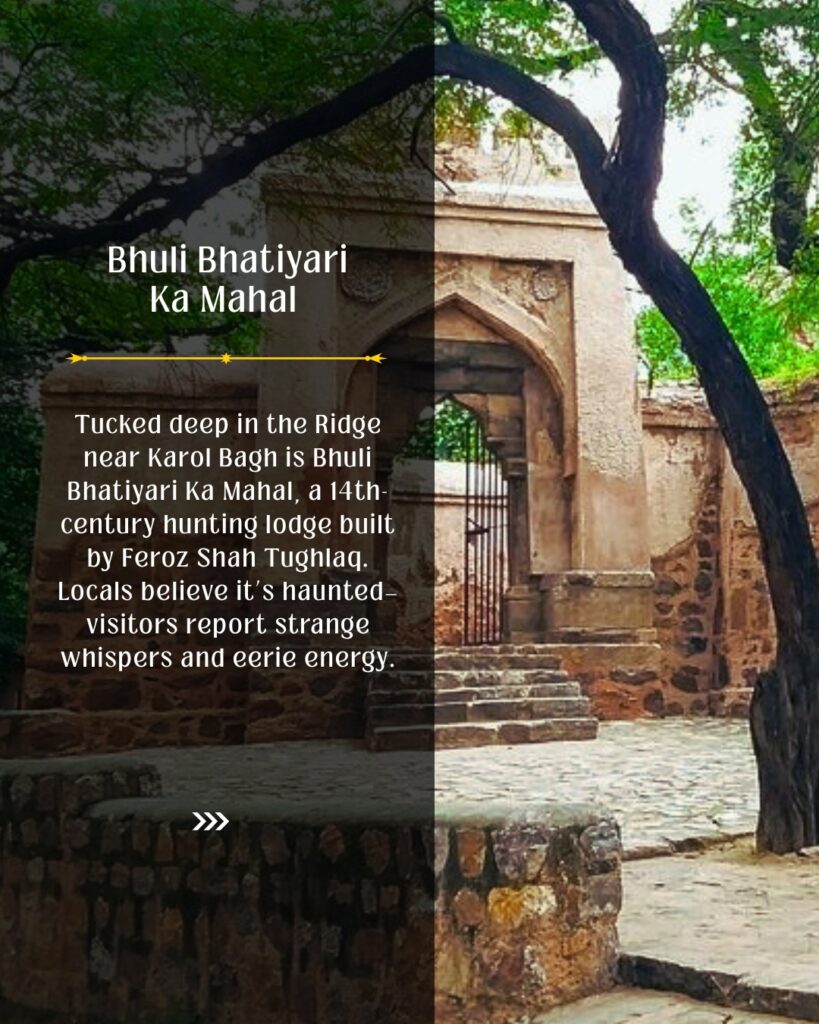
One of the Ridge’s most mysterious structures is Bhuli Bhatiyari Ka Mahal, a 14th-century hunting lodge built by Feroz Shah Tughlaq.
Tucked in the forest near Karol Bagh, the structure lies in ruins today. Locals believe it’s haunted—people have reported hearing whispers, and many avoid the area after sunset. Whether it’s folklore or fact, the atmosphere is undeniably eerie.
A Witness to Rebellion: The 1857 Revolt
The Northern Ridge played a key role during the First War of Independence in 1857. After Indian sepoys captured Delhi, the British forces took position on the Ridge and laid siege to the city.
The Mutiny Memorial, later renamed Ajitgarh, stands here—a reminder of both colonial rule and India’s fight for freedom. This makes the Ridge not just an ecological zone, but a war memorial in disguise.
British-Era Leopard Hunts
Few know that in the 19th and early 20th centuries, the Ridge was home to leopards. British officers stationed in Delhi organized hunting parties in the forest—especially in the areas around what is now Delhi University.
Today, while leopards are rare, the southern Ridge still sees occasional sightings. Conservation efforts are now focused on protecting these remaining wild habitats.

An Ancient Rock Edict Hidden in Bahapur
One of Delhi’s oldest inscriptions lies hidden in the Ridge near Bahapur—a rock edict of Emperor Ashoka, dating back to the 3rd century BCE. It predates most monuments in the city and connects Delhi to the legacy of the Mauryan Empire.
This proves that Delhi was culturally significant even before the Sultanate, Mughal, or British eras.

Delhi’s Therapy Spot
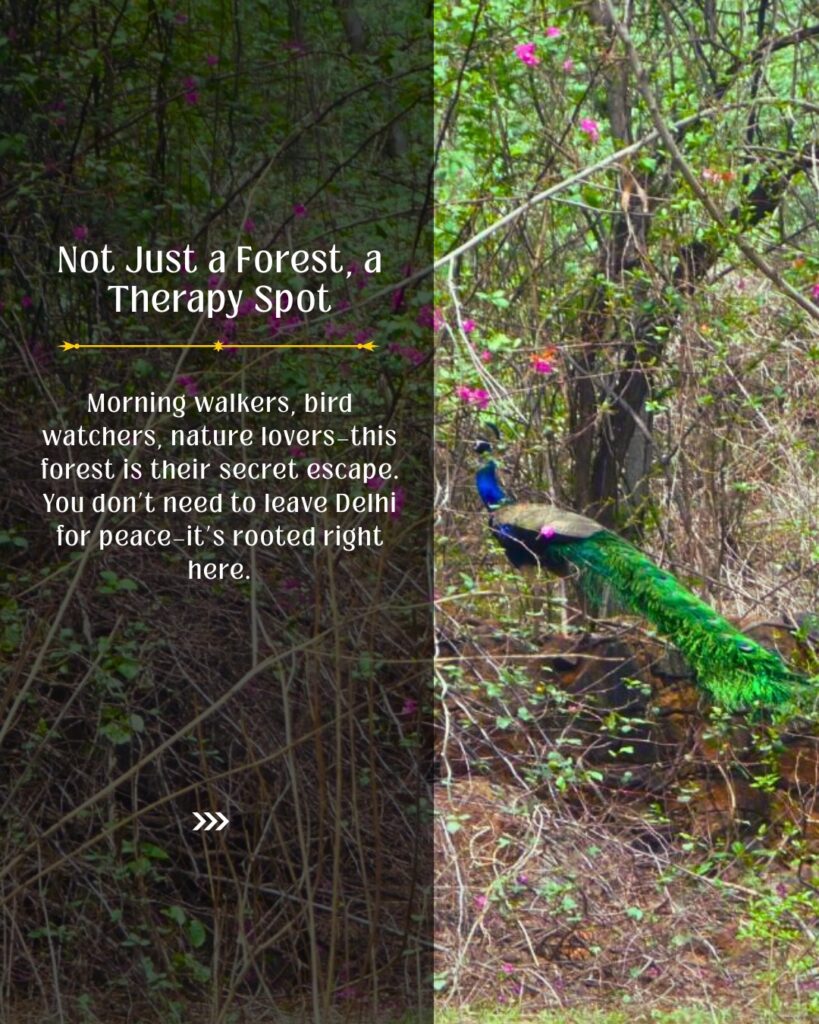
Beyond history and biodiversity, the Ridge is also a sanctuary for city-weary souls. Early mornings here are filled with birdsong, rustling leaves, and fresh air. Walkers, joggers, yoga enthusiasts, and photographers use this space to reconnect with nature.
Unlike Lodi Garden or Nehru Park, this isn’t manicured or curated. It’s raw. It’s real. And it’s magical.
Delhi’s Best-Kept Secret
The Delhi Ridge is not just a forest. It’s a living, breathing time capsule — containing stories of prehistoric Earth, medieval kings, colonial battles, and modern-day survival.
Most Delhiites pass by it daily, unaware of the billion-year-old wonder beside them.
So the next time you’re stuck in traffic or scrolling for a weekend plan, skip the malls.
Head to the Ridge. Walk in silence. Listen to the city’s forgotten voice.