

Alai Minar: Echoes of an Unfinished Tower
The Story of Alai Minar – Alauddin Khilji’s Tower of Ambition
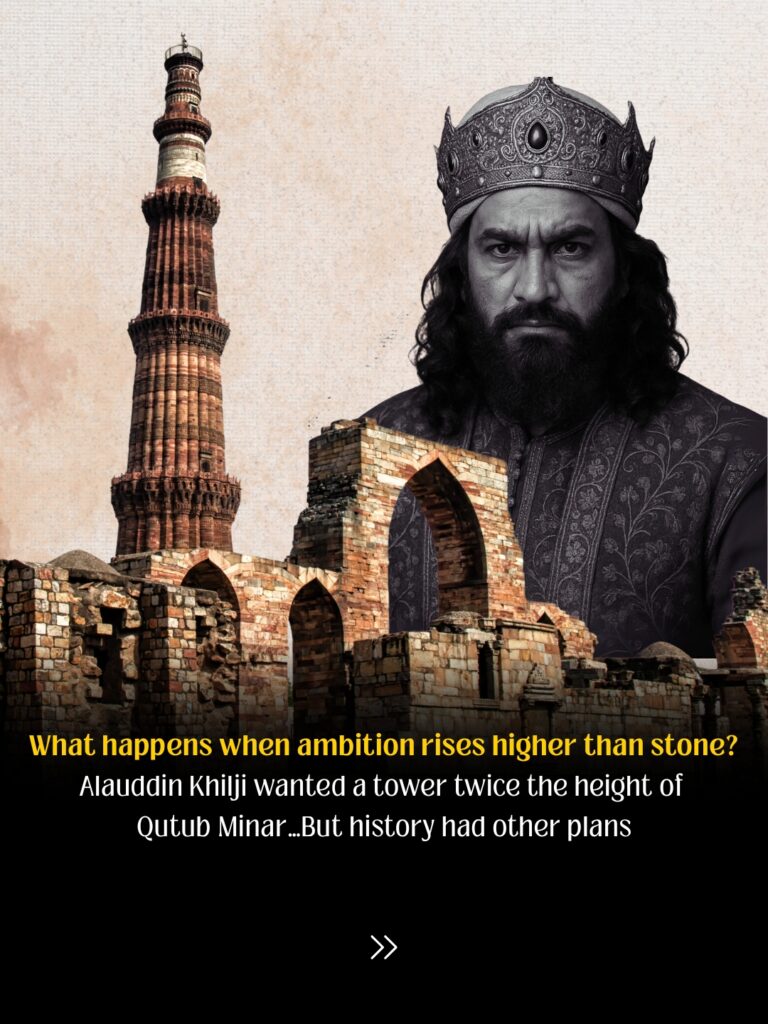
In the shadow of Delhi’s iconic Qutub Minar lies a massive, stunted stone structure that tourists often walk past without a second glance. This is the Alai Minar, a monument that was meant to surpass the Qutub Minar in height, grandeur, and legacy — but today, it stands as a haunting reminder of ambition cut short.
The Sultan Who Dreamt Too High
The story of Alai Minar begins with Alauddin Khilji (r. 1296–1316 CE), one of the most powerful, ambitious, and controversial rulers of the Delhi Sultanate. He styled himself as Sikander-i-Sani, or the Second Alexander, and had every intention of making history remember him that way.
Under his rule, Khilji’s armies swept across much of India — conquering Chittor, Ranthambore, Gujarat, Malwa, and pushing further into South India, defeating powerful dynasties like the Yadavas, Hoysalas, Kakatiyas, and Pandyas. His victories brought immense wealth to Delhi, and with it, the confidence to undertake monumental construction projects that would reflect his might.
Alai Minar: The Tower That Never Was
Flush with power, Khilji decided to leave behind a symbol of his supremacy — a “Tower of Victory” twice the size of the already colossal Qutub Minar. He also ordered the expansion of the Quwwat-ul-Islam Mosque nearby, increasing its enclosure four times in size to suit the scale of his vision.
According to the court poet Amir Khusro, in his book Tarikh-i-Alai, Alauddin wished to “raise a minar so high that it could not be exceeded.” The construction of the Alai Minar likely began around 1300 CE, but tragedy would strike before it could climb further.
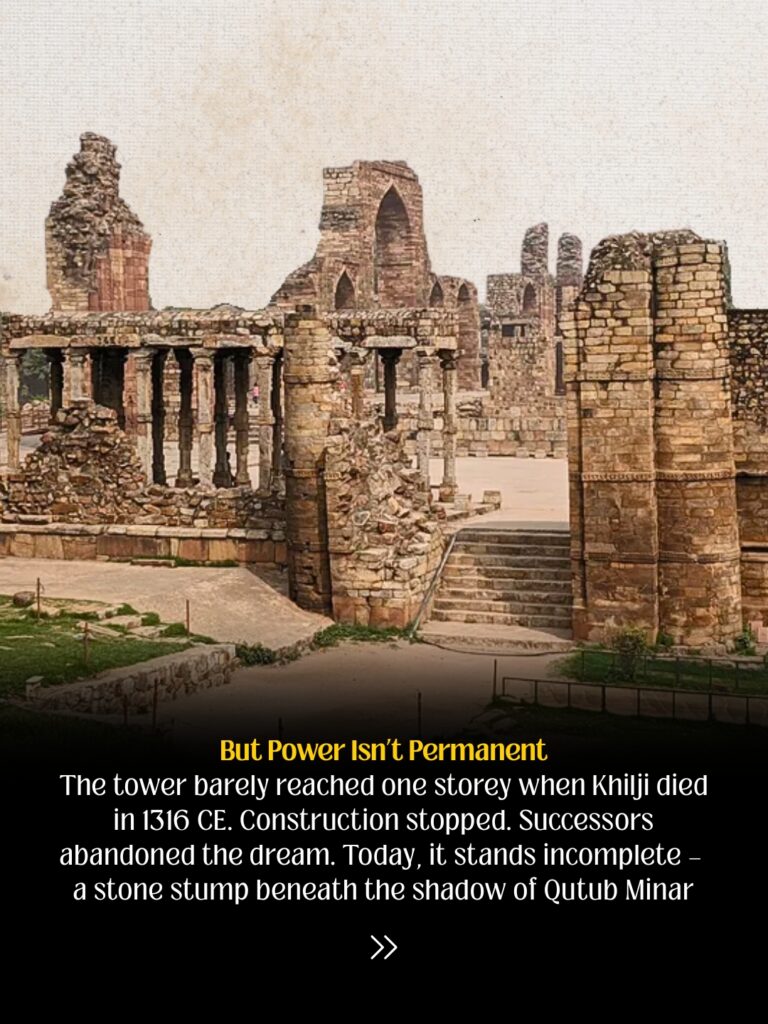
When Alauddin Khilji died in 1316 CE, the project came to a sudden halt. His successors had little interest in completing their predecessor’s ego-driven dream. What remains today is a massive, rough, circular core of rubble masonry — about 27 metres tall, only a fraction of the planned height.

What You See Today
The Alai Minar still sits inside the Qutub Complex, surrounded by better-known structures. Its unfinished form — six storeys high, without ornamentation or inscription — stands as a curious contrast to the refined elegance of the Qutub Minar.
What was supposed to be a towering legacy, ended up as a monument to unfulfilled ambition.
Alauddin Khilji wanted to outshine the past — instead, he was buried beneath it.
📍 Visitor Info
Location: Qutub Minar Complex, Mehrauli, New Delhi
Entry Fee: ₹35 (Indians) | ₹550 (Foreigners)
Best Time to Visit: Early morning or late afternoon for softer light and fewer crowds
Don’t just visit the Qutub Minar — take a moment to walk over to the Alai Minar. It may not scrape the sky, but it tells a story that still echoes through stone.