

Where Memory and Power Still Stand Side by Side
A British Memorial, Reclaimed by India
Ajitgarh, formerly known as the Mutiny Memorial, is one of the most striking yet misunderstood monuments on Delhi’s Northern Ridge. Built in 1863 by the British colonial government, it originally served to honour British officers, soldiers, and their Indian allies who died during the Revolt of 1857. For the British, the memorial symbolised victory and imperial authority.
After Independence, however, the structure became a controversial reminder of colonial power. In 1972, on the 25th anniversary of India’s freedom, the Government of India officially renamed it Ajitgarh, meaning “Invincible Fort”. A new plaque was installed declaring that the “enemy” mentioned in the British inscriptions were, in fact, Indians who fought bravely for national liberation.
The renaming did not erase the past. Instead, it added a new layer of meaning, transforming Ajitgarh into a complex site of remembrance that reflects both colonial history and India’s reclaiming of its narrative.
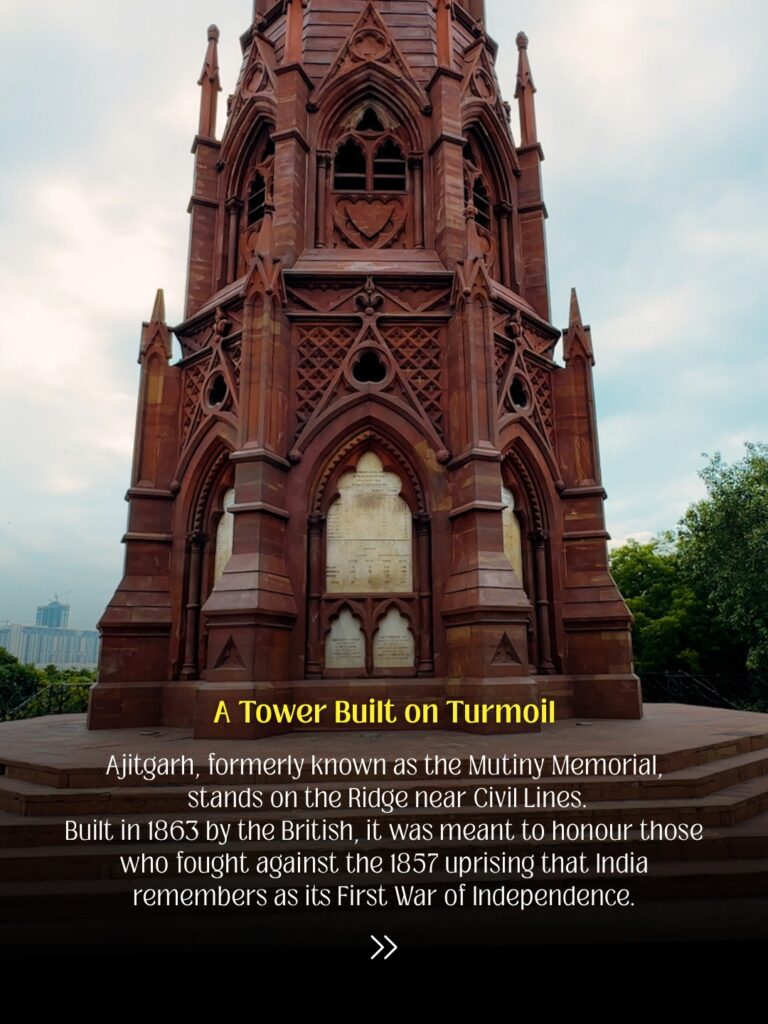
Built After the Revolt of 1857
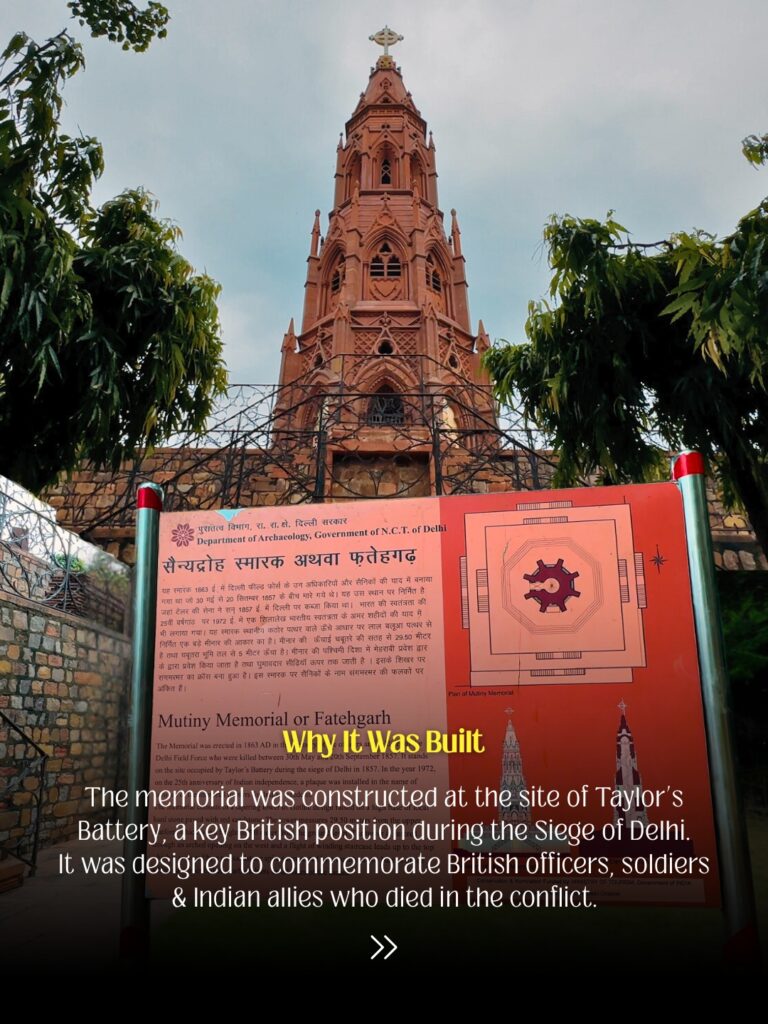
The monument stands on the very site once occupied by Taylor’s Battery during the siege of Delhi in 1857. It was one of the key positions from which the British fired upon the city before retaking it.
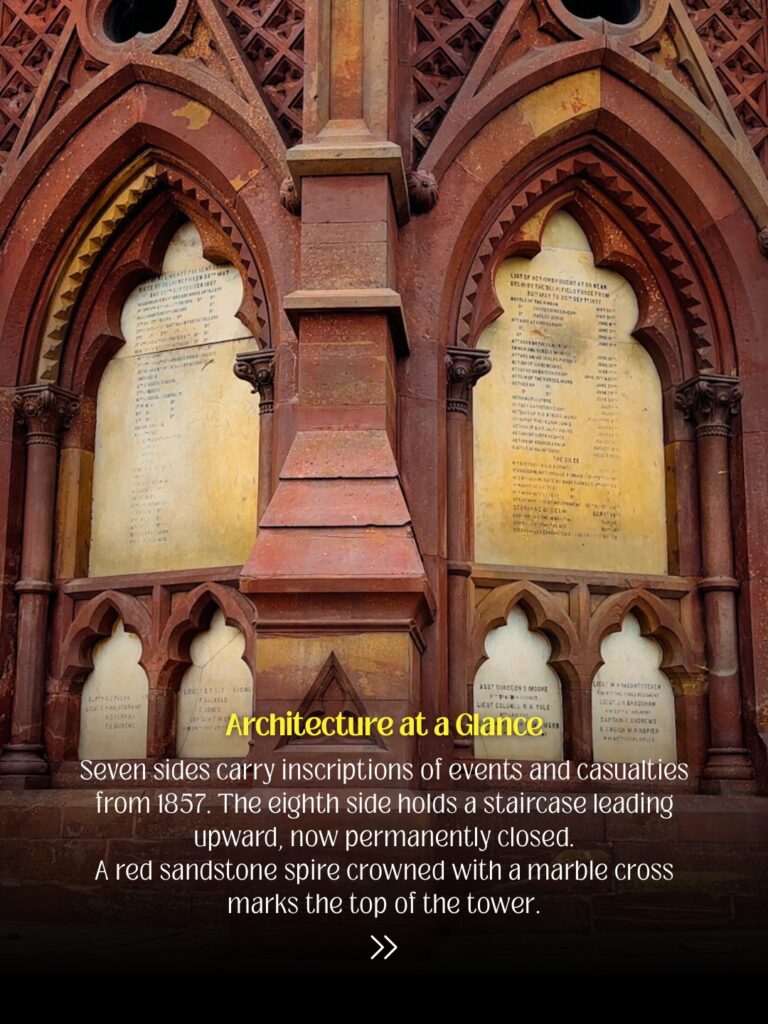
Constructed just six years after the revolt, the memorial was a political statement as much as a funerary monument. It listed British casualties with precision, yet omitted hundreds of Indian rebels who died in the same conflict. Of the 1,029 men killed, only 47 names were inscribed, reinforcing the colonial hierarchy even in death.
The plaques narrate the events of the siege entirely from a British perspective, which is why the reinterpretation in 1972 sought to challenge that narrative.
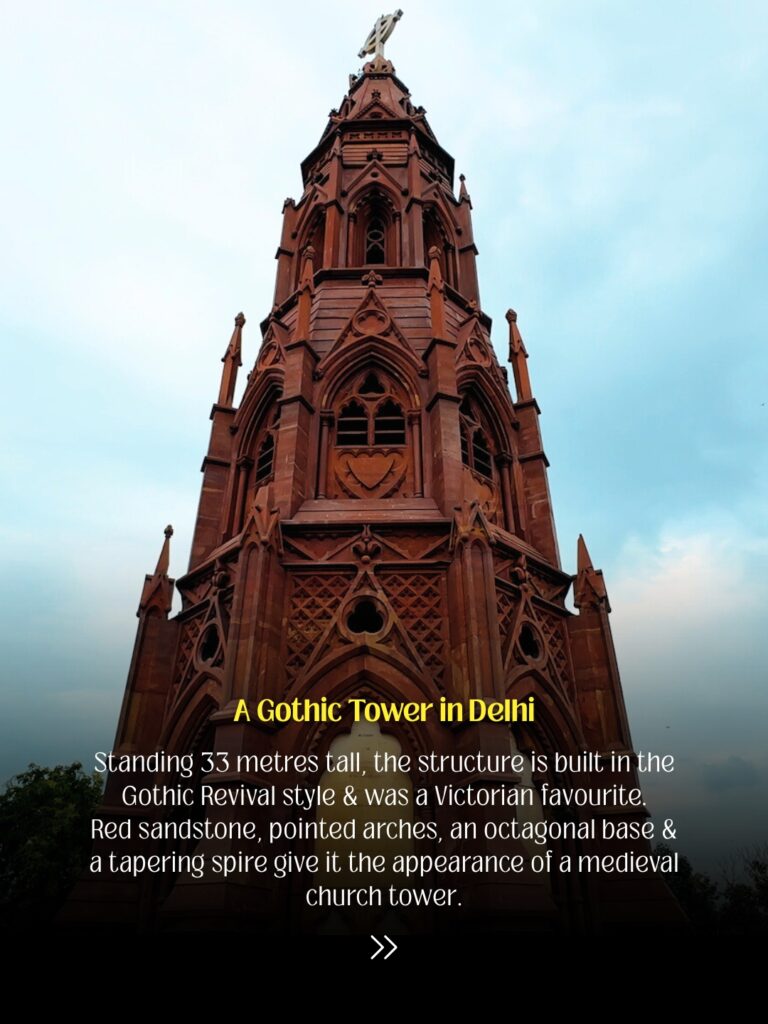
A Gothic Revival Monument in the Heart of Delhi
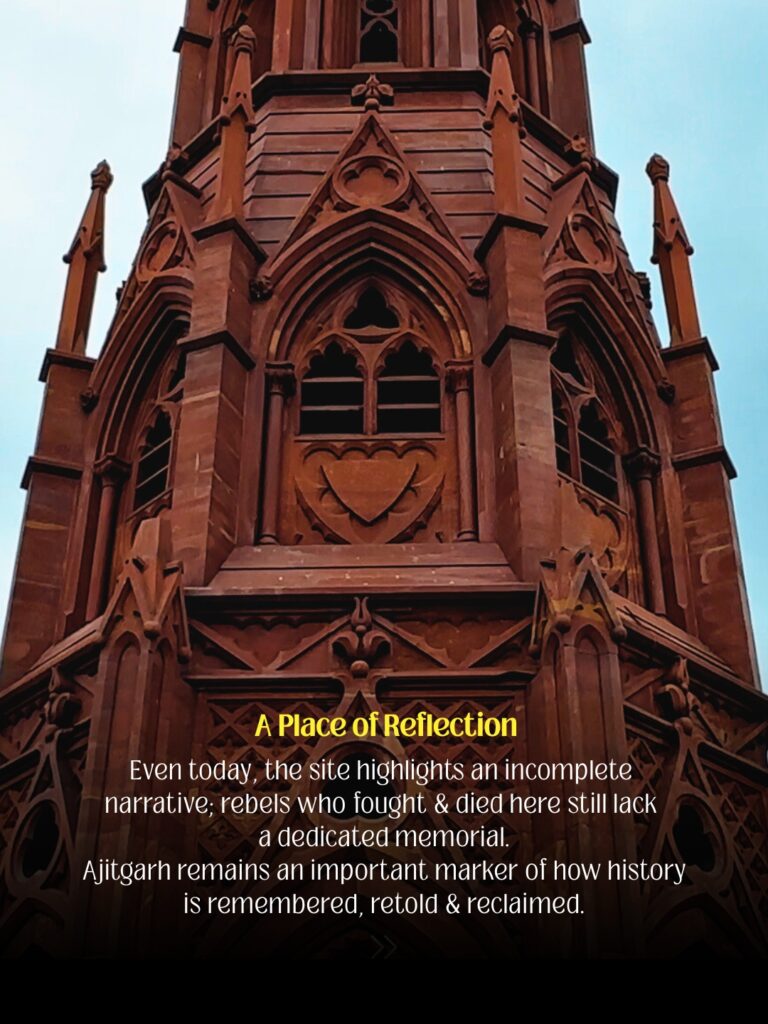
Architecturally, Ajitgarh stands out sharply against Delhi’s predominantly Indo-Islamic landscape. Built in red sandstone, the 33-metre structure rises like a medieval tower or church spire, reflecting the Gothic Revival style popular in Victorian-era Britain.
Key architectural features include
• An octagonal plan raised on a high plinth
• A tapering, multi-tiered tower construction
• Arched western entrance leading to internal staircases
• Tall, narrow window openings
• A sandstone spire crowned with a marble cross
Seven sides contain long inscriptions detailing British accounts of the revolt. The eighth side has a staircase leading to the upper levels, though these have been permanently closed for public safety.
Ajitgarh is one of the clearest examples of Victorian Gothic architecture in Delhi and visually distinct from monuments built by earlier Indian dynasties.
From Colonial Symbol to Contested Memory
For decades after Independence, the Mutiny Memorial was viewed with discomfort. To many Indians, it represented a monument that glorified the suppression of freedom fighters.
In 1972, the Indian government intervened. The memorial was renamed Ajitgarh, sometimes interpreted to mean “place of the vanquished”, depending on the historian. A government plaque reframed the narrative, stating clearly that the “enemy” recorded on British inscriptions were Indians who fought bravely for national liberation.
This reinterpretation was meant to reposition the monument within the Indian freedom struggle, but no separate memorial for the rebels was created. Ajitgarh therefore stands today as an unusual space — a British monument carrying Indian counter-memory, two parallel histories inscribed on the same stone.
A Quiet Space for Reflection Today
Today, Ajitgarh sits quietly on the Northern Ridge, surrounded by greenery and often overlooked by visitors. What was once a symbol of colonial victory has become a point of reflection on how history is written, remembered, and reclaimed.
It remains open to the public, offering a sweeping view of Delhi’s layered past — from rebellion and violence to reinterpretation and independence.
Plan Your Visit
Location: Northern Ridge, near Delhi University
Entry: Free, open to visitors during daylight hours
Best for: History enthusiasts, architecture lovers, students of colonial history, and those interested in the story of the 1857 Revolt
Nearby sites: Flagstaff Tower, Chauburja Mosque, Mutiny Trail landmarks